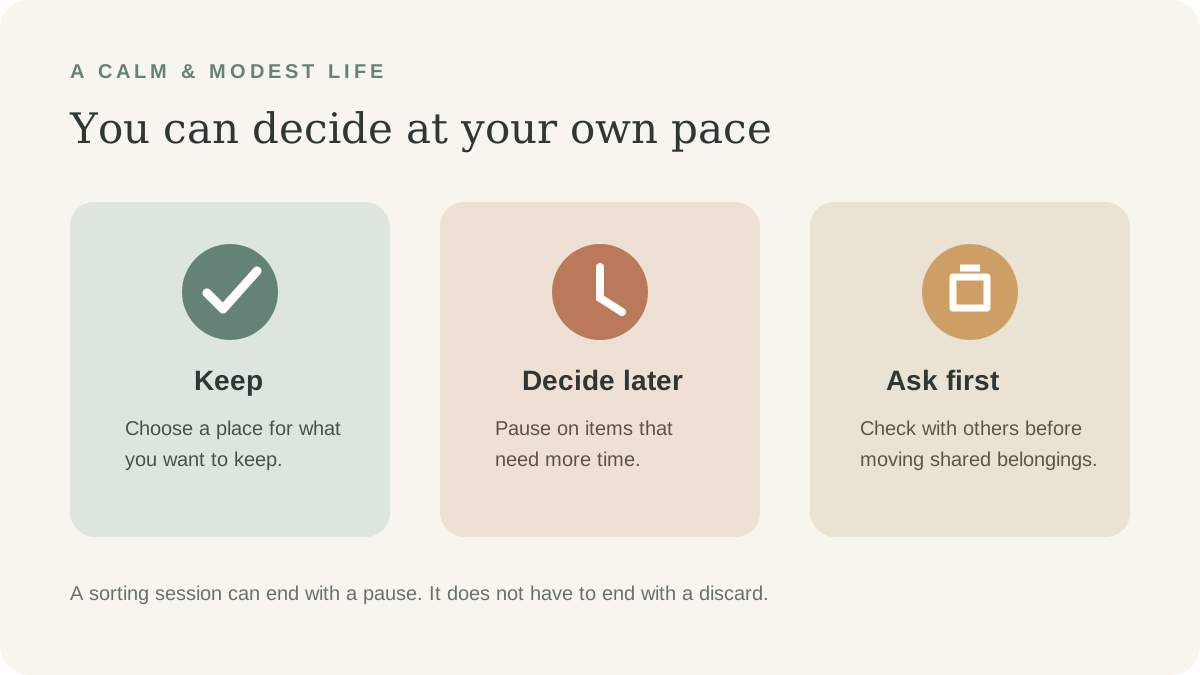
You can sort sentimental belongings without deciding to let them go. Start with one small group, keep what feels meaningful, and set aside uncertain items for a later decision.
You don’t have to answer that question for every object in one afternoon. The goal can be smaller: make the collection easier to live with, keep what matters to you, and leave a decision for later when you’re not ready.
Start with your own belongings and one small group
Choose one category, such as greeting cards, souvenirs, children’s artwork, or objects from a particular trip. Avoid emptying every closet or opening every family box at once. A single manageable group lets you make a few decisions without turning the day into a full-house project.
If an item is shared, inherited, or belongs to someone else, pause before sorting it. The University of Minnesota Extension’s resource on passing along personal possessions notes that belongings can mean different things to different family members and that these decisions can strain relationships. A conversation may matter more than a tidy shelf.
Separate “keep” from “decide today”
Make three temporary groups: keep, pass along, and decide later. “Decide later” is a real choice, especially when you’re tired or the item brings up a complicated memory. Give that group a container with a limit, such as one small box or one shelf, so it stays visible and doesn’t quietly spread.
You can also choose a review date, but it doesn’t have to be a deadline. The purpose is to make the question easier to return to, not to force yourself to feel differently by a certain day.
Keep the memory in the form that suits you
Some objects are meaningful because you use or see them. Others matter because of the story attached to them. You might display a postcard, keep a few pages from a larger stack, photograph a child’s artwork, or write down who gave you an object and why you kept it.
These are options, not rules. A photograph of something is not automatically a substitute for the original, and you don’t need to reduce a collection to a prescribed number. Try a small change only if it feels helpful to you.
Make room without making a “perfect” collection
If you want to keep many items, choose a home that fits the collection. A labeled box, album, drawer, or shelf can make it easier to find things later. Grouping items by person, year, or event can help, but there is no single correct system.
For papers and small objects, it may help to keep a short note with the item. A name or one-sentence story can preserve context for you or another family member. Keep sensitive personal information private when labeling or photographing belongings.
Ask before passing along shared or family items
For a shared item, write down who has a stake in the decision, where it will stay for now, and a date to ask them. If ownership or wishes are unclear, leave it in place. A photograph can help document the item, but it does not replace someone else's consent or the object itself.
Before donating, giving away, or discarding something that may matter to another person, ask them. Be specific about what you have and what decision you’re considering. You can offer a clear pickup date if you need the space, while still giving the person a chance to respond.
The University of Minnesota Extension resource above is designed for more involved decisions about transferring possessions. If a family conversation feels difficult, it offers questions and materials to help people talk through what items mean and how to handle them. This guide is about everyday organizing, not legal or estate advice.
Try a ten-minute version
Pick one small group. Set aside what you already know you want to keep. Put uncertain pieces in a bounded “decide later” space. Write a quick note about anything someone else should be consulted about. Then stop.
If you want to continue, you can return another day. If not, you have still made the collection more visible and easier to revisit. For a broader starting point, see our guide to decluttering without buying more storage.
TRY SOMETHING SMALL TODAY
Want one small next step?
Our free seven-day checklist has one short home action for each day. Download it if that would help; the guide works on its own.
Download the free checklist ↓