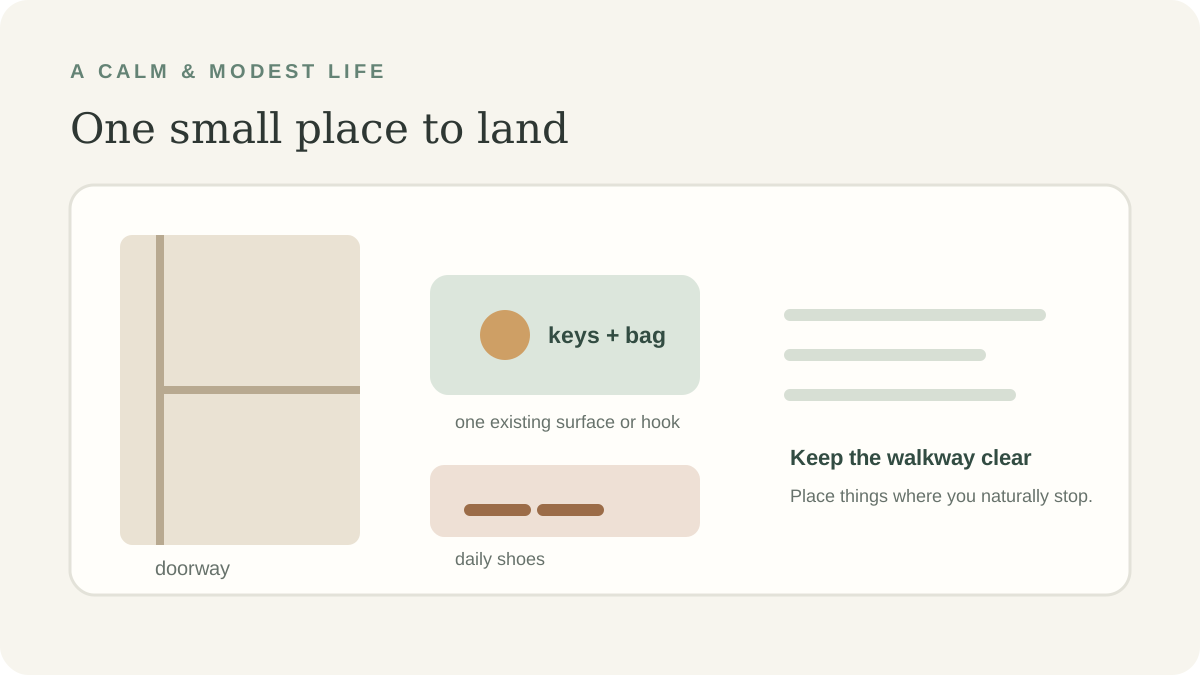
You can organize a small apartment entryway without adding furniture: give the shoes, bags, and keys you use most a simple place to land, then test the setup before buying anything.
Notice what happens when you come home
For one or two days, pay attention to what you set down first. It might be keys and a bag. It might be shoes, a work badge, or a child’s backpack. Notice where each item already ends up. That spot is a useful starting point, even if it is not beside the front door.
You are looking for a routine that fits the way you move through your home, not an entryway that looks like a catalog photo.
Choose one landing spot
Try a one-minute arrival audit before moving anything: put down the things you actually carried today, then note where each item landed. Is the walkway clear? Could you find keys again with one hand free? If a bag or shoes belong to someone else, ask before moving them. This is a design check, not a test you can fail.
Pick a small area close to where you naturally stop: a shelf, a corner of a counter, a hook, or a section of floor that stays clear. If your front door opens into the living room, the landing spot might be beside the place where you put down your bag rather than beside the door itself.
Keep the first version small. A dish you already own may hold keys. A reusable bag can collect items that need to leave with you. An existing hook can take a coat or tote. Use only what makes the next arrival easier.
Give the busiest items a clear home
Choose homes for the few things that create the most friction. Keys might go in the same bowl each time. Shoes might stay together on a washable mat you already have. Mail can go in one short-term pile with a day to sort it, instead of spreading across every surface.
If several people share the space, make the arrangement easy for everyone to use. Keep walkways clear, and don’t put small objects where someone could trip over or mistake them for something to discard.
Try the setup before buying anything
A small test for the next three arrivals
For your keys, everyday bag, and most-used shoes, note where each lands now and one place to try. After the third arrival, mark each spot keep, move, or remove. A note on your phone is enough.
If the chosen spot obstructs a door or a clear path, move it. After three arrivals, keep the parts that worked and change one thing that did not. Buying storage only makes sense if you can name the remaining problem and measure the space.
Use the landing spot for a week. If keys keep landing somewhere else, move the bowl there. If shoes overflow, decide which pairs belong near the door and store occasional pairs elsewhere. A routine that works in your home is more useful than the perfect-looking basket that nobody uses.
If you still think storage would help after trying the routine, measure the space and check what you already own first. Our guide to decluttering without buying more storage walks through deciding whether a container solves a real problem.
Reset it in a minute
When you leave, take the things that need to go with you. When you return, put the daily essentials in their spots. Once a week, clear anything that has collected there by accident.
If you don’t have a separate entryway, you haven’t failed to organize one. You only need a small landing place that makes coming and going a little easier.
TRY SOMETHING SMALL TODAY
Want one small next step?
Our free seven-day checklist has one short home action for each day. Download it if that would help; the guide works on its own.
Download the free checklist ↓